
Vault Mode
19. Vault Mode (Cloud Backup)
Section titled “19. Vault Mode (Cloud Backup)”Added (2026-02-09): Defines the Blind Replica architecture — a relay operating in vault mode for long-term encrypted backup. See
docs/research/blind-replica-architecture.mdfor full research context.
19.1 Overview
Section titled “19.1 Overview”Vault mode is a relay configuration that provides long-term encrypted storage for Cloud Backup. It reuses the existing relay binary, protocol, and BlobStorage trait — the only differences are retention policy and storage backend.
| Property | Transit Mode (current) | Vault Mode (new) |
|---|---|---|
| Purpose | Ephemeral message passing | Long-term encrypted backup |
| Retention | TTL (default 7 days) | Unlimited |
| Storage | Local SQLite | Object storage (R2/B2/S3) |
| Content blobs | Not stored | Stored via iroh-blobs |
| Cleanup | cleanup_expired() runs hourly | No expiry cleanup |
| Cursor tracking | Per-group | Per-group (same mechanism) |
| Zero-knowledge | Yes | Yes |
| Deployment | Global, latency-sensitive | Centralized, near storage region |
19.2 Design Principles
Section titled “19.2 Design Principles”| Principle | Meaning |
|---|---|
| No new crate | Vault mode is a relay config variant, not a separate binary |
| No new protocol | Same envelopes, same content refs, same push/pull |
| No TTL | Stored blobs do not expire; deleted only on explicit request |
| Object storage | Blobs stored in R2/B2, not local SQLite |
| Thin proxy | Vault relay holds cursor metadata locally; blob data is remote |
| Separate deployment | Transit and vault relays run independently for failure isolation |
19.3 Storage Modes
Section titled “19.3 Storage Modes”The relay’s StorageConfig gains a mode field:
[storage]mode = "transit" # Current behavior: SQLite, TTL cleanup# ormode = "vault" # New: object storage, no TTLTransit mode (default): Unchanged from Section 7. SQLite storage, TTL-based cleanup, per-group quotas. All existing behavior is preserved.
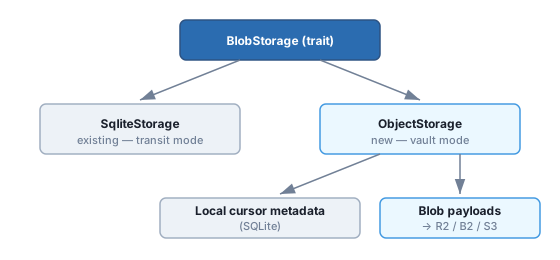
Vault mode: The BlobStorage trait (already defined in sync-relay/src/storage/mod.rs) gains a new implementation backed by object storage. The trait contract does not change — store_blob(), get_blobs_after(), cleanup_expired(), etc. all have the same signatures. The vault implementation simply:
- Stores blob payloads in object storage (R2/B2) keyed by
{group_id}/{cursor} - Keeps cursor metadata in a local SQLite (lightweight, <100MB for 100K users)
- Returns a no-op from
cleanup_expired()(nothing expires)
19.4 Object Storage Backend
Section titled “19.4 Object Storage Backend”The new ObjectStorage struct implements the existing BlobStorage trait:
Object key scheme:
{bucket}/{group_id_hex}/{cursor_padded}Example: vk-vault/a1b2c3d4.../000000000042
Cursor is zero-padded to 15 digits for lexicographic ordering, enabling prefix scans for pull operations.
Operations mapping:
BlobStorage method | Object storage behavior |
|---|---|
store_blob() | PUT object + INSERT cursor metadata locally |
get_blobs_after() | SELECT cursors locally → GET objects by key |
get_max_cursor() | SELECT from local metadata |
mark_delivered() | UPDATE local metadata (same as transit) |
cleanup_expired() | No-op (returns 0 deleted) |
get_group_storage() | SUM from local metadata (payload sizes tracked locally) |
get_blob() | GET single object by blob_id |
API compatibility:
| Provider | API | Notes |
|---|---|---|
| Cloudflare R2 | S3-compatible | Free egress (recommended for restore-heavy workload) |
| Backblaze B2 | S3-compatible | Cheaper storage, paid egress |
| AWS S3 | Native | Higher cost, global availability |
| MinIO | S3-compatible | Self-hosted option |
All providers use the S3-compatible API via the rust-s3 or aws-sdk-s3 crate. The implementation is provider-agnostic.
19.5 Vault Mode Configuration
Section titled “19.5 Vault Mode Configuration”[storage]mode = "vault"
# Object storage backendbackend = "r2" # "r2", "b2", "s3", "minio"bucket = "vk-vault"endpoint = "https://xxx.r2.cloudflarestorage.com"access_key_id = "${VAULT_ACCESS_KEY}"secret_access_key = "${VAULT_SECRET_KEY}"region = "auto" # R2 uses "auto"
# Local metadata database (cursor tracking, delivery status)metadata_database = "/data/vault-meta.db"
# Quotasmax_group_storage = 53687091200 # 50 GB fair use cap per groupmax_blob_size = 10485760 # 10 MB per blob (larger than transit's 1MB)
[storage.content]enabled = true # Accept iroh-blobs for content storagemax_content_per_group = 53687091200 # 50 GB content cap per groupEnvironment variable overrides (for container deployment):
| Variable | Purpose |
|---|---|
VAULT_ACCESS_KEY | Object storage access key |
VAULT_SECRET_KEY | Object storage secret key |
VAULT_BUCKET | Bucket name |
VAULT_ENDPOINT | S3-compatible endpoint URL |
19.6 Content Blob Storage
Section titled “19.6 Content Blob Storage”Transit relays do not store content blobs — large files transfer device-to-device via iroh-blobs (Section 17). Vault relays additionally participate as an iroh-blobs peer to capture content for backup.
When Cloud Backup is ON:
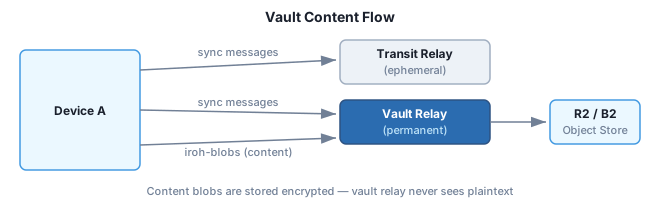
The vault relay runs an iroh-blobs server that accepts content blob transfers. Each blob is stored as a separate object in the same bucket, keyed by content hash:
{bucket}/{group_id_hex}/content/{content_hash_hex}Content blobs use the same encrypt-then-hash pipeline defined in Section 17 — the vault relay receives already-encrypted ciphertext and its BLAKE3 hash. It stores the ciphertext without decryption.
19.7 Client Cloud Backup Toggle
Section titled “19.7 Client Cloud Backup Toggle”The sync-client gains a CloudBackup configuration:
enum CloudBackup { Off, // Default. Push to transit relay(s) only. On { vault_relay_address: String, // Vault relay endpoint },}Behavior when ON:
push()sends to transit relay(s) AND vault relay- Content transfers also target the vault relay’s iroh-blobs endpoint
- Vault push is fire-and-forget (does not block the primary push acknowledgement)
Behavior when OFF:
- Same as current behavior. No vault relay interaction.
The toggle is a local user preference. It does not affect the protocol, the encryption, or any relay behavior. The vault relay does not know whether a user has the toggle ON or OFF — it simply receives pushes like any other relay.
19.8 Restore Flow
Section titled “19.8 Restore Flow”Restore uses the existing pull protocol. No new messages or endpoints required.
Full restore (all devices lost):
- Application (VardKista) provides group_id and vault relay address (from Recovery Kit — see
docs/research/blind-replica-architecture.md) sync-clientconnects to vault relaysync-client.pull(group_id, after_cursor: 0)— pulls all stored blobs from the beginning- Content blobs retrieved via iroh-blobs from vault relay
- Application decrypts and rebuilds local state
Partial restore (existing device available):
- New device pairs with existing device (existing pairing flow)
- New device syncs from transit relay AND vault relay
- CRDTs merge state from all sources — no conflict resolution needed
The vault relay does not distinguish between a “restore” pull and a normal pull. Both are the same operation: get_blobs_after(group_id, cursor).
19.9 Quotas and Fair Use
Section titled “19.9 Quotas and Fair Use”| Limit | Value | Enforcement |
|---|---|---|
| Max storage per group | 50 GB | get_group_storage() check before store_blob() |
| Max blob size | 10 MB | Same as transit (checked in handle_push()) |
| Max content per group | 50 GB | Separate tracking for iroh-blobs content |
| Total per-group cap | 100 GB | Sync messages + content combined |
When a group exceeds its quota, store_blob() returns QuotaExceeded. The client handles this gracefully — the application can prompt the user to manage storage.
19.10 Data Lifecycle
Section titled “19.10 Data Lifecycle”| Event | Action |
|---|---|
| Cloud Backup ON | Vault relay starts receiving pushes. Full sync from transit relay history (if available within TTL). |
| Cloud Backup OFF | Vault relay stops receiving new pushes. Existing data preserved for 30 days. |
| 30 days after OFF | All group data purged from object storage. Cursor metadata deleted. |
| Re-enable within 30 days | Resume from last cursor. No re-sync needed. |
| Re-enable after 30 days | Full re-sync from device. |
| User requests deletion | Immediate: all blobs for group deleted from object storage. Metadata purged. |
Deletion is simple: The vault relay controls the R2 bucket. Deletion = DELETE all objects with the group’s prefix + DELETE local metadata rows. No scattered copies in analytics, CDNs, or backup systems.
19.11 Security Properties
Section titled “19.11 Security Properties”All security properties from Section 4 are preserved. Additionally:
| Property | How |
|---|---|
| Zero-knowledge | Vault relay stores encrypted blobs. Same ciphertext as transit. No keys. |
| No new attack surface | Same protocol, same message types, same authentication. |
| Object storage isolation | Each group’s data under a unique prefix. No cross-group access. |
| Deletion completeness | Object storage has no hidden caches or replicas beyond what the bucket provides. |
| Metadata minimality | Vault metadata is cursor positions and payload sizes. No content, no filenames, no timestamps beyond ordering. |
What the vault relay can observe (unchanged from transit):
- Blob sizes
- Group IDs (opaque)
- Device public keys (pseudonymous)
- Timing of push/pull operations
- IP addresses (at connection level, not logged)
What the vault relay cannot observe:
- Blob contents (encrypted)
- File names, types, or structure
- User identity or account information
- Relationships between groups
19.12 Infrastructure Sizing
Section titled “19.12 Infrastructure Sizing”Vault relays and transit relays are separate deployments with different scaling profiles:
| Property | Transit Relay | Vault Relay |
|---|---|---|
| Container size | CX22 (4GB RAM, 40GB disk) | CX11 (2GB RAM, 20GB disk) |
| Scaling factor | Concurrent connections | Bandwidth (restore throughput) |
| Data location | Local SQLite | Object storage (remote) |
| Local disk usage | 5-20 GB (active messages) | <1 GB (cursor metadata only) |
| Global distribution | Yes (latency-sensitive) | No (colocate near object storage) |
| Failure impact | Real-time sync degrades | Backup/restore unavailable, sync unaffected |
See docs/research/blind-replica-architecture.md for detailed cost analysis at scale.
Appendix A: Crate Dependencies
Section titled “Appendix A: Crate Dependencies”sync-types
Section titled “sync-types”[dependencies]serde = { version = "1", features = ["derive"] }rmp-serde = "1"uuid = { version = "1", features = ["v4", "serde"] }sync-core
Section titled “sync-core”[dependencies]sync-types = { path = "../sync-types" }sync-client
Section titled “sync-client”[dependencies]sync-types = { path = "../sync-types" }sync-core = { path = "../sync-core" }sync-content = { path = "../sync-content" } # Large content transfertokio = { version = "1", features = ["rt", "sync", "time"] }clatter = "2.2" # Hybrid Noise protocol (ML-KEM-768 + X25519)iroh = "0.96" # Endpoint, connections, discovery (all tiers) - requires cargo patchargon2 = "0.5"chacha20poly1305 = "0.10" # Supports XChaCha20rand = "0.8"thiserror = "1"tracing = "0.1"sync-content
Section titled “sync-content”[dependencies]sync-types = { path = "../sync-types" }iroh-blobs = "0.98" # Content-addressed storage with BLAKE3/Baoiroh = "0.96" # Endpoint for transfers - requires cargo patchchacha20poly1305 = "0.10" # XChaCha20-Poly1305 for content encryptionblake3 = "1" # Hashing ciphertext for content addresshkdf = "0.12" # Content key derivation from GroupSecretsha2 = "0.10" # HKDF-SHA256tokio = { version = "1", features = ["rt", "sync", "fs"] }thiserror = "1"tracing = "0.1"sync-relay
Section titled “sync-relay”[dependencies]sync-types = { path = "../sync-types" }tokio = { version = "1", features = ["full"] }iroh = "0.96" # Endpoint for accepting client connections (QUIC) - requires cargo patchclatter = "2.2" # Hybrid Noise protocol (ML-KEM-768 + X25519)sqlx = { version = "0.8", default-features = false, features = ["sqlite", "runtime-tokio", "derive"] }axum = "0.7" # Health/metrics HTTP endpoints onlytower = "0.4"tracing = "0.1"tracing-subscriber = "0.3"config = "0.14"sync-bridge
Section titled “sync-bridge”[package]name = "zerok-sync-bridge"
[lib]crate-type = ["rlib"]
[dependencies]sync-client = { path = "../sync-client" }sync-types = { path = "../sync-types" }tokio = { version = "1", features = ["rt-multi-thread", "sync", "time"] }thiserror = "1"tracing = "0.1"sync-node (napi-rs)
Section titled “sync-node (napi-rs)”[package]name = "zerok-sync-node"
[lib]crate-type = ["cdylib"]
[dependencies]sync-bridge = { path = "../sync-bridge" }napi = { version = "3", features = ["async", "tokio_rt"] }napi-derive = "3"
[build-dependencies]napi-build = "2"sync-python (PyO3)
Section titled “sync-python (PyO3)”[package]name = "zerok-sync-python"
[lib]name = "zerok_sync"crate-type = ["cdylib"]
[dependencies]sync-bridge = { path = "../sync-bridge" }pyo3 = { version = "0.28", features = ["extension-module", "abi3-py310"] }pyo3-async-runtimes = { version = "0.28", features = ["tokio-runtime"] }tokio = { version = "1", features = ["rt-multi-thread"] }Framework Integration: Tauri Plugin (updated)
Section titled “Framework Integration: Tauri Plugin (updated)”# tauri-plugin-sync — now depends on sync-bridge, not sync-client directly[dependencies]sync-bridge = { path = "../sync-bridge" }tauri = "2"tauri-plugin = "2"serde = { version = "1", features = ["derive"] }serde_json = "1"