
Executive Summary
1. Problem Statement
Section titled “1. Problem Statement”The Sync Gap in Local-First Applications
Section titled “The Sync Gap in Local-First Applications”Modern applications increasingly adopt local-first architecture—data lives on the device, works offline, and syncs opportunistically. This approach delivers superior user experience: instant responsiveness, offline capability, and data ownership.
However, sync is hard. Developers face a painful choice:
| Option | Problem |
|---|---|
| Firebase/Supabase | Vendor lock-in, data leaves device unencrypted, recurring costs |
| Build custom | Months of networking, encryption, conflict resolution work |
| Skip sync | Users stuck on single device, competitive disadvantage |
The Local-First Ecosystem Gap
Section titled “The Local-First Ecosystem Gap”Local-first frameworks (Tauri, Electron, React Native, Flutter) have matured for building desktop and mobile applications. Developers can build, package, and distribute apps easily.
Missing piece: Sync. Local-first developers have no turnkey, zero-knowledge solution for multi-device synchronization that doesn’t require trusting a third party with their users’ data.
2. Solution: 0k-Sync
Section titled “2. Solution: 0k-Sync”Core Architecture
Section titled “Core Architecture”A zero-knowledge relay that passes encrypted blobs between devices. The relay never sees plaintext data—it’s a dumb pipe.
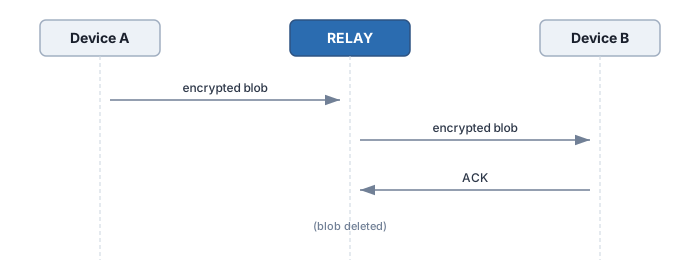
Multi-relay fan-out (Phase 6.5): Clients push to multiple relays simultaneously. Primary relay is awaited; secondaries are fire-and-forget. On connect, the client tries each relay in order until one succeeds (automatic failover). Each relay tracks cursors independently.
Key insight: The client library stays constant. Only the relay tier changes.
What We’re Building
Section titled “What We’re Building”| Component | Purpose |
|---|---|
| sync-client | Rust library for E2E encryption, pairing, cursor tracking, multi-relay failover |
| sync-content | Large file transfer via iroh-blobs (encrypt-then-hash) |
| sync-relay | Stateless message router with temporary buffering (runs independently per region) |
| sync-bridge | FFI bridge — resolves generic SyncClient<T> into concrete SyncHandle for bindings |
| sync-node | napi-rs bindings — @0k-sync/native npm package for Bun/Node.js/Deno |
| sync-python | PyO3 bindings — zerok-sync pip package for Python 3.10+ |
What We’re NOT Building
Section titled “What We’re NOT Building”- Data storage — Relay is pass-through only, not a database
- Conflict resolution — CRDTs are app responsibility (we transport blobs)
- User accounts — Zero-knowledge pairing via QR/codes
- Proprietary dependencies — 100% open source stack
3. Technical Validation Status
Section titled “3. Technical Validation Status”Production Readiness Gates
Section titled “Production Readiness Gates”Three gates must be addressed before GA release:
| Gate | Status | Action Required |
|---|---|---|
| Security Audit | ✅ Complete | Two audits complete (2026-02-05). 35 findings, 0 critical/high remaining. Noise Protocol (clatter) implemented. |
| Enterprise Compliance | ⚠️ Blocked | ”FIPS Mode” fallback using AES-GCM/PBKDF2 for regulated markets |
| Infrastructure | ✅ Ready | Cloudflare Tunnel validated; self-hosted iroh-relay option |
Validated Technology Choices
Section titled “Validated Technology Choices”| Component | Choice | Version | Validation |
|---|---|---|---|
| P2P networking | iroh | 0.96 | 200K+ connections, stable API |
| Transport encryption | iroh QUIC (TLS 1.3) | 0.96 | Wire encryption via iroh |
| Noise Protocol | clatter | 2.2 | Hybrid ML-KEM-768 + X25519 |
| Large content | iroh-blobs | 0.98 | BLAKE3/Bao verified streaming |
| Blob encryption | XChaCha20-Poly1305 | RustCrypto | 192-bit nonces, no coordination needed |
| Key derivation | Argon2id | RustCrypto | Device-adaptive parameters |
| Transport | iroh | 0.96 | QUIC P2P + relay fallback |
| Storage | SQLite + WAL | via sqlx | 70K+ writes/sec |
iroh Version Strategy:
- Production: iroh 0.96 (requires cargo patch for curve25519-dalek)
- Content transfer: iroh-blobs 0.98 for large files
- Discovery: mDNS (LAN), DNS, optional DHT
⚠️ Dependency Note: iroh 0.96 requires a cargo patch for curve25519-dalek 5.0.0-pre.1. See workspace Cargo.toml
[patch.crates-io]section. PR #878 submitted upstream.
4. Architecture Overview
Section titled “4. Architecture Overview”Protocol Stack
Section titled “Protocol Stack”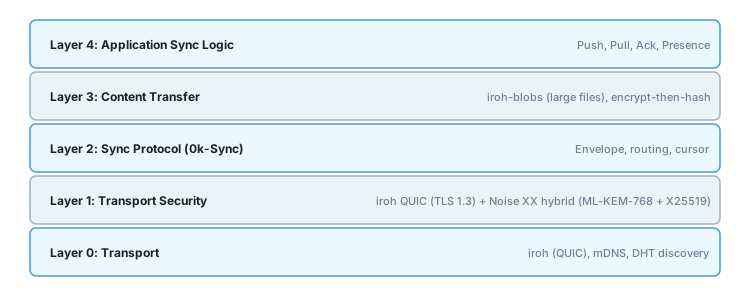
Cryptographic Primitives
Section titled “Cryptographic Primitives”| Function | Algorithm | Notes |
|---|---|---|
| Cipher | XChaCha20-Poly1305 | 192-bit nonce (not 96-bit) |
| Transport | iroh QUIC (TLS 1.3) | Wire encryption |
| KDF | Argon2id | Device-adaptive: 19-64 MiB based on RAM (OWASP minimum: 19 MiB) |
Why XChaCha20 (not standard ChaCha20)?
- 192-bit nonces eliminate collision risk (safe threshold: 2^80 vs 2^32)
- Random nonce generation safe without cross-device coordination
- Negligible performance overhead (one HChaCha20 block)
Security Model
Section titled “Security Model”| Property | How Achieved |
|---|---|
| Zero-knowledge relay | E2E encryption with Group Key; relay sees only ciphertext |
| No accounts | Devices pair via QR code or short code; no email/password |
| Forward secrecy | iroh QUIC TLS (transport level). Noise Protocol XX planned for application-level forward secrecy. |
| Replay protection | Monotonic cursors + nonces |
| Relay redundancy | Multi-relay fan-out with automatic connect failover (Phase 6.5) |
Mobile Architecture: Wake-on-Push
Section titled “Mobile Architecture: Wake-on-Push”Mobile platforms kill background network connections within ~30 seconds of backgrounding. Solution:
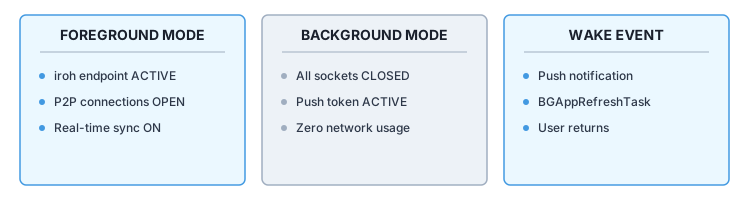
Key principle: Never block on app close. Fire-and-forget flush with 500ms timeout. Stranded commits sync on next launch.
5. Product Tiers
Section titled “5. Product Tiers”Six tiers serve the full market:
| Tier | Infrastructure | Target User |
|---|---|---|
| 1. Vibe Coder | iroh public network | Hobbyist, zero setup |
| 2. Home Developer | Self-hosted Docker | Privacy-focused |
| 3. Vercel-style | Container on PaaS | Startup on budget |
| 4. Community Sync | Managed Cloud shared | Indie developer |
| 5. Cloud | Managed Cloud dedicated | Funded startup |
| 6. Enterprise | Customer infrastructure | Regulated industry |
Developer Experience (All Tiers):
// One line to add syncuse sync_client::SyncClient;
let client = SyncClient::new(SyncConfig::default()).await?;client.push(encrypted_blob).await?;
Changing tiers = changing one config value. No code changes.
6. Implementation Approach
Section titled “6. Implementation Approach”Crate Structure
Section titled “Crate Structure”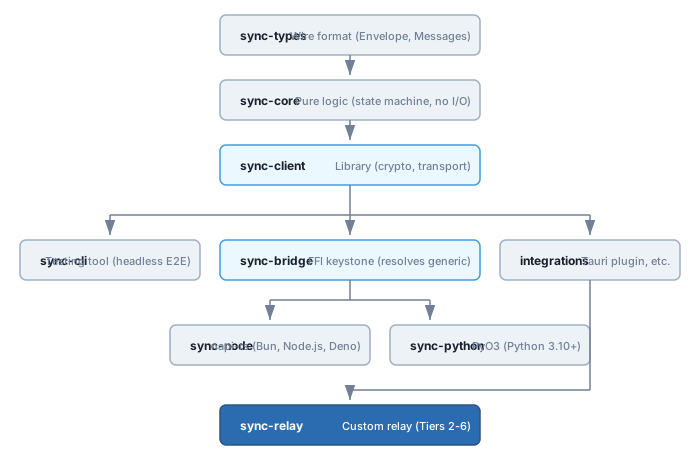
Test-Driven Development
Section titled “Test-Driven Development”| Crate | Test Strategy |
|---|---|
| sync-types | Serialization round-trip |
| sync-core | Pure logic, instant tests (no I/O) |
| sync-client | Crypto verification, mock transport |
| sync-cli | E2E headless scripts |
| integrations | Framework-specific tests |
Critical Implementation Requirements
Section titled “Critical Implementation Requirements”From research validation:
- Thundering Herd Mitigation — Client-side exponential backoff with jitter on reconnect
- Device-Adaptive Argon2 — 12 MiB (low-end) to 64 MiB (desktop) based on available RAM
- XChaCha20 Nonces — 192-bit random nonces, never 96-bit
- Noise Protocol — Hybrid clatter with ML-KEM-768 + X25519 implemented
- iroh 0.96 — Pre-1.0 but stable, requires cargo patch (see Cargo.toml)
7. Risk Summary
Section titled “7. Risk Summary”| Risk | Severity | Mitigation |
|---|---|---|
| Post-quantum transition | Low | Hybrid Noise (clatter ML-KEM-768) implemented |
| FIPS compliance gap | Critical (for Gov/Finance) | Feature flag for AES-GCM/PBKDF2 build |
| iroh ecosystem maturity | Low | Using stable 0.96; self-hosted option; multi-relay failover implemented |
| Mobile battery impact | Medium | Wake-on-Push architecture; quantify in beta |
| Thundering herd | Medium | Client-side jitter required |
8. Summary
Section titled “8. Summary”| Question | Answer |
|---|---|
| What is it? | Zero-knowledge sync protocol for local-first apps |
| Who is it for? | Local-first developers (any framework) |
| Why build it? | Fills the sync gap in local-first ecosystem |
| How does it scale? | Client constant, relay tier changes |
| What’s validated? | iroh 0.96 (E2E tested), XChaCha20-Poly1305, Argon2id, multi-relay fan-out. Multi-language bindings implemented (napi-rs, PyO3). Hybrid Noise Protocol (clatter ML-KEM-768 + X25519) implemented. 750+ tests across the workspace + 63 chaos scenarios. |
| What’s blocked? | FIPS compliance (enterprise only) |
0k-Sync completes local-first apps: Build → Store Locally → Sync Securely.
References
Section titled “References”- iroh by n0-computer — P2P networking (0.96)
- iroh-blobs — Content-addressed storage (0.98)
- clatter crate — Hybrid Noise Protocol (implemented)
- Noise Protocol — Encryption framework
- Research Validation — Full technology validation