
Security Model
4. Security Model
Section titled “4. Security Model”4.1 Key Hierarchy
Section titled “4.1 Key Hierarchy”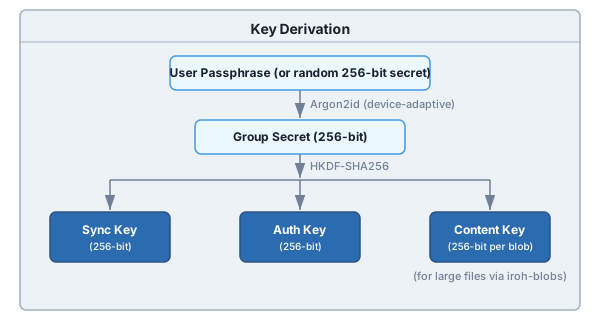
Content Key Derivation (for large file transfer via iroh-blobs):
Large content (photos, documents, audio) uses a separate key derived per-blob to allow independent lifecycle management:
content_key = HKDF-SHA256( ikm = GroupSecret, salt = "0k-sync-content-v1", info = blob_id || "content-encryption") → 32 bytes for XChaCha20-Poly1305This allows:
- Same key for all devices in the group (they share GroupSecret)
- Independent rotation from sync blob encryption key
- Per-blob key isolation (compromise of one content key doesn’t affect others)
Device-Adaptive Argon2id Parameters:
OWASP minimum (19 MiB, 2 iterations) performs well on modern devices but hits 800ms+ on low-end mobile. Use device-adaptive parameters:
| Device Class | Detection Signal | Memory | Iterations | Target Time |
|---|---|---|---|---|
| Low-end / mid-range mobile | RAM < 4GB | 19 MiB | 2 | 200-400ms |
| High-end mobile | RAM 4-8GB | 46 MiB | 1 | 200-400ms |
| Desktop | RAM >= 8GB | 64 MiB | 3 | 200-500ms |
CL-001 (2026-02-05): Lowest tier raised from 12 MiB / 3 iter to OWASP minimum (19 MiB / 2 iter). No device class falls below OWASP floor.
iOS Constraint: AutoFill extension processes have ~55 MiB usable memory. Configurations above 46 MiB fail intermittently.
4.2 Noise Protocol Configuration
Section titled “4.2 Noise Protocol Configuration”Status: The Noise Protocol layer is implemented using the
clattercrate. Transport security uses hybrid Noise XX (ML-KEM-768 + X25519) over iroh QUIC. Audit finding F-002 has been resolved.
Handshake Pattern: XX (mutual authentication)
XX: → e ← e, ee, s, es → s, seWhy XX:
- Both parties prove identity
- Neither needs pre-shared keys
- Forward secrecy from message 2
Cryptographic Primitives (Hybrid Post-Quantum):
| Function | Algorithm | Crate |
|---|---|---|
| Key Exchange | X25519 + ML-KEM-768 | clatter v2.1+ |
| Cipher | ChaChaPoly | clatter v2.1+ |
| Hash | BLAKE2s | clatter v2.1+ |
Hybrid Handshake: Uses
noise_hybrid_XXpattern with ML-KEM-768 (NIST Level 3) for quantum resistance. The clatter crate provides the verified hybrid Noise protocol implementation.
4.3 Device Identity
Section titled “4.3 Device Identity”- Each device generates Curve25519 keypair on first launch
- Public key = Device ID (32 bytes, base64 for display)
- Private key stored in OS keychain (via platform-specific secure storage)
4.4 Threat Model
Section titled “4.4 Threat Model”| Threat | Mitigation |
|---|---|
| Relay reads data | E2E encryption; relay sees only ciphertext |
| MITM attack | iroh TLS + Noise XX mutual auth |
| Replay attack | Nonces + monotonic cursors |
| Device compromise | Per-device keys; rotate Group Key to revoke |
| Relay compromise | No plaintext stored; temporary buffer only |
| Traffic analysis | Optional PADME padding (future) |
4.5 Trust Assumptions
Section titled “4.5 Trust Assumptions”- User’s devices are not compromised
- iroh QUIC TLS is sound, augmented by hybrid Noise Protocol
- Argon2id parameters are sufficient
- Relay is honest-but-curious