Content Transfer
16. Push Notification Integration
Section titled “16. Push Notification Integration”⚠️ Critical for Mobile: Push notifications are not optional for production mobile apps. Without them, users must manually open the app to receive synced data.
16.1 Architecture
Section titled “16.1 Architecture”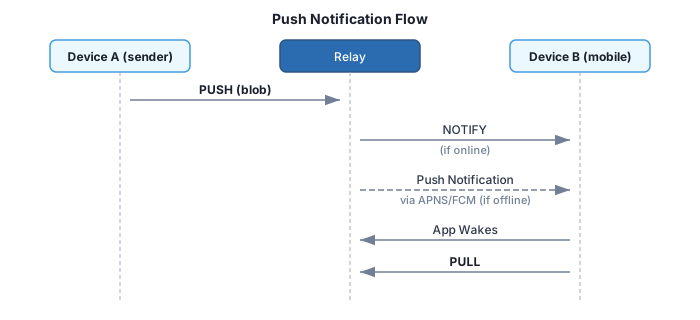
16.2 Client API (Day 1 Requirements)
Section titled “16.2 Client API (Day 1 Requirements)”The sync-client MUST expose push token hooks from Day 1, even if backend integration comes later:
// sync-client API
impl SyncClient {    pub async fn register_push_token(        &self,        token: String,        platform: PushPlatform,    ) -> Result<()>;
    pub async fn unregister_push_token(&self) -> Result<()>;}
pub enum PushPlatform {    Apns,      // Apple Push Notification Service    Fcm,       // Firebase Cloud Messaging    Web,       // Web Push (future)}
// JavaScript/TypeScript bindings (for JS-based frameworks)export interface SyncClient { // ... existing methods ...
// Push notification integration (Day 1) registerPushToken(token: string, platform: 'apns' | 'fcm'): Promise<void>; unregisterPushToken(): Promise<void>;
// Event for handling push-triggered wake on(event: 'push-wake', handler: () => void): void;}16.3 Message Specification
Section titled “16.3 Message Specification”REGISTER_PUSH
Section titled “REGISTER_PUSH”pub struct RegisterPush { /// Platform-specific push token pub token: String,
/// Platform identifier pub platform: PushPlatform,
/// App bundle ID (for APNS) pub app_id: Option<String>,}UNREGISTER_PUSH
Section titled “UNREGISTER_PUSH”pub struct UnregisterPush { /// Reason for unregistering pub reason: UnregisterReason,}
pub enum UnregisterReason { UserDisabled, TokenExpired, AppUninstalled,}16.4 Relay Push Behavior
Section titled “16.4 Relay Push Behavior”On PUSH (when recipient offline):
async fn handle_push_for_offline_device(    device: &Device,    blob: &Blob,    push_service: &PushService,) {    if let Some(push_token) = device.push_token {        // Send silent push notification        let notification = PushNotification {            token: push_token,            platform: device.push_platform,            payload: PushPayload::SilentSync {                group_id: blob.group_id,                cursor: blob.cursor,            },            // Silent push - no user-visible notification            content_available: true,            alert: None,        };
        push_service.send(notification).await?;    }}
16.5 iOS/Android Integration
Section titled “16.5 iOS/Android Integration”iOS (APNS):
// In your iOS app delegatefunc application(_ application: UIApplication,                 didRegisterForRemoteNotificationsWithDeviceToken deviceToken: Data) {    let token = deviceToken.hexString    // Pass to your sync client (adapt to your framework's native bridge)    SyncClient.shared.registerPushToken(token: token, platform: .apns)}
func application(_ application: UIApplication,                 didReceiveRemoteNotification userInfo: [AnyHashable: Any],                 fetchCompletionHandler: @escaping (UIBackgroundFetchResult) -> Void) {    // Silent push received - trigger sync    SyncClient.shared.handlePushWake()    fetchCompletionHandler(.newData)}
Android (FCM):
// In your Firebase messaging serviceclass SyncFirebaseService : FirebaseMessagingService() {    override fun onNewToken(token: String) {        // Pass to your sync client (adapt to your framework's native bridge)        SyncClient.getInstance().registerPushToken(token, PushPlatform.FCM)    }
    override fun onMessageReceived(message: RemoteMessage) {        if (message.data["type"] == "sync") {            // Trigger sync in background            SyncClient.getInstance().handlePushWake()        }    }}
16.6 Implementation Phases
Section titled “16.6 Implementation Phases”| Phase | Scope | Dependency |
|---|---|---|
| Day 1 | Client API hooks (register/unregister) | None |
| Day 1 | Message types (REGISTER_PUSH, etc.) | sync-types |
| Phase 5 | Relay stores push tokens | sync-relay |
| Phase 5 | Relay sends to APNS/FCM | Push service integration |
| Future | Web Push support | Service workers |
Key Point: The client-side hooks MUST exist from Day 1 so apps can register tokens. The relay-side push sending can come later, but the API contract must be stable.
17. Large Content Transfer Protocol
Section titled “17. Large Content Transfer Protocol”Amendment (2026-02-02): Added per iroh-deep-dive-report.md recommendations.
17.1 The Problem
Section titled “17.1 The Problem”The sync protocol is optimized for small encrypted blobs (app state, JSON entries, ~100 KB sweet spot). When apps need to sync photos (2-10 MB), voice memos (1-5 MB), document scans (0.5-3 MB), or PDFs, pushing megabytes through a relay designed for kilobytes is inefficient.
Affected use cases by app type:
| App Type | Content | Size Range | Frequency |
|---|---|---|---|
| Journal apps | Photos, voice memos | 1-15 MB | High (daily) |
| Health apps | Meal photos, progress pics, scans | 1-10 MB | High |
| Finance apps | Receipt scans, invoice PDFs | 0.5-5 MB | Medium |
| Note apps | Article images, PDF attachments | 0.5-20 MB | Medium |
| Contact apps | Contact photos | 50-500 KB | Low (small enough for sync relay) |
| Password managers | None | — | None |
17.2 Architecture: Encrypt-Then-Hash with iroh-blobs
Section titled “17.2 Architecture: Encrypt-Then-Hash with iroh-blobs”Large content bypasses the sync relay entirely. The relay handles only small metadata; actual content transfers device-to-device via iroh-blobs.
Flow:
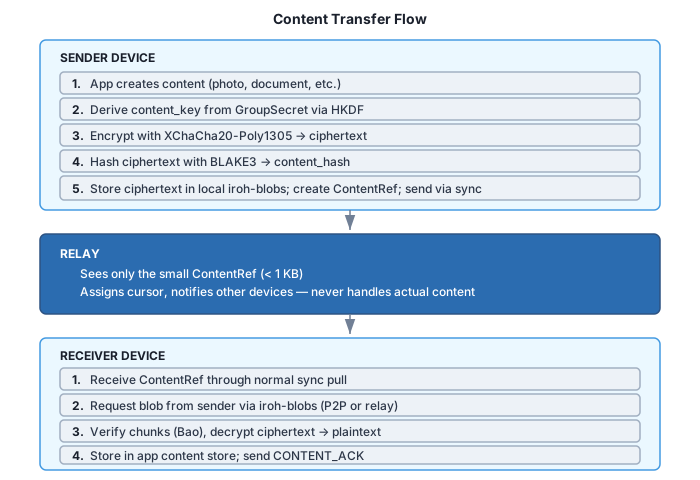
Key properties:
- iroh-blobs sees only ciphertext — BLAKE3 hash is of encrypted bytes
- Resumable — iroh-blobs resumes from last verified chunk if interrupted
- Verified — every 16 KiB chunk integrity-checked during streaming
- No relay load — large files travel P2P, relay handles only metadata
17.3 ContentReference Message
Section titled “17.3 ContentReference Message”See Wire Protocol — Section 5.3 for the full struct definition. Key fields:
| Field | Purpose |
|---|---|
content_hash | BLAKE3 hash of ciphertext (iroh-blobs address) |
encryption_nonce | XChaCha20-Poly1305 nonce for decryption |
content_size | Original size (for UI progress) |
mime_type | Content type for app handling |
thumbnail_hash | Optional preview (encrypted, much smaller) |
17.4 Content Key Derivation
Section titled “17.4 Content Key Derivation”See Security Model — Section 4.1 for the HKDF derivation. Same key for all devices in the group.
17.5 Garbage Collection
Section titled “17.5 Garbage Collection”| Device | GC Strategy |
|---|---|
| Sender | Keeps blob tagged until all devices ACK |
| Receiver | Drops tag after successful download + local storage |
| Orphan protection | Sender keeps tag for grace period (30 days) if ContentRef deleted before all fetches |
17.6 Mobile Considerations
Section titled “17.6 Mobile Considerations”Thumbnail-first strategy:
- Show “Photo attached” immediately (from ContentRef)
- Show thumbnail if
thumbnail_hashpresent (tiny iroh-blobs fetch) - Download full resolution on demand or WiFi
Background transfer:
- Queue large downloads for WiFi / charging
- iroh-blobs handles resumption natively
- iOS/Android background fetch can trigger thumbnail downloads
Storage quota:
- Each app manages its own content storage budget
- Old content can be evicted and re-fetched (ContentRef persists in sync log)
17.7 Offline / Asynchronous Transfer
Section titled “17.7 Offline / Asynchronous Transfer”| Scenario | Solution |
|---|---|
| Same LAN | mDNS direct discovery → LAN-speed transfer |
| Different networks, both online | iroh relay forwards encrypted blobs |
| Asynchronous (rarely online together) | Pending downloads queue, resume on next app foreground |
| Future enhancement | Relay-hosted blob cache with TTL (deployment optimization) |
17.8 Discovery Configuration
Section titled “17.8 Discovery Configuration”// Enable mDNS for same-LAN direct transfer (recommended)let discovery = ConcurrentDiscovery::new() .add(MdnsDiscovery::new()) // LAN discovery .add(DnsDiscovery::new(dns_url)) // Our DNS server .add(DhtDiscovery::new()); // Fallback (optional)
let endpoint = Endpoint::builder() .discovery(discovery) .relay_mode(RelayMode::Custom(our_relay_map)) // Our infrastructure only .build() .await?;17.9 Self-Hosted Infrastructure
Section titled “17.9 Self-Hosted Infrastructure”For production deployments, run your own iroh infrastructure:
| Component | Purpose | Deployment |
|---|---|---|
iroh-relay | Encrypted datagram relay when P2P fails | Docker, any VPS |
iroh-dns-server | Endpoint discovery by ID | Docker, your domain |
| mDNS | LAN discovery | Zero infrastructure |
| DHT | Decentralized fallback | Zero infrastructure |
Configuration:
// Disable n0 default relays, use only our infrastructurelet relay_map = RelayMap::from_url("https://relay.yourdomain.com".parse()?);This ensures zero runtime dependency on any third party.