
Orchestrator Pattern
A capable model orchestrates while cheaper models execute structured subtasks. Combined with mandatory workflow structure on every specialist, this pattern delivers 50%+ cost reduction and 2-3x speed improvement with no measurable quality loss.
Executive summary
Section titled “Executive summary”| Approach | Cost (input/output per 1M tokens) | Latency | Quality |
|---|---|---|---|
| All-capable (every call uses premium model) | $15 / $75 (5 premium calls) | ~60s sequential | Baseline |
| Orchestrator + specialists | $7 / $35 (1 premium + 4 cheap) | ~19s parallel | Equal or better |
| Savings | 53% cost reduction | 68% time reduction | No loss |
The key requirement: every specialist must have structured workflow built in. Without it, cheaper models are unreliable. With it, they match or exceed premium model quality on well-defined tasks.
The architecture
Section titled “The architecture”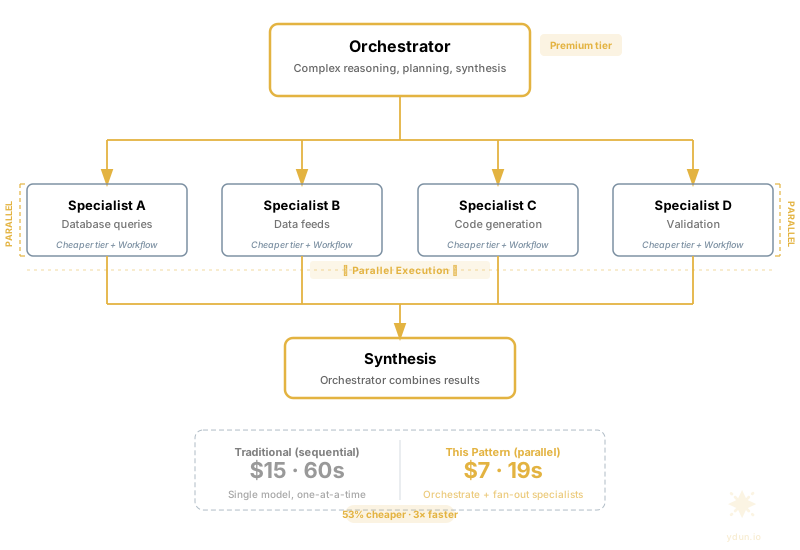
Orchestrator (capable model) │ │ Complex reasoning, task decomposition, synthesis │ ├── Specialist 1 (cheaper model + structured workflow) │ Structured subtask with validation gates │ ├── Specialist 2 (cheaper model + structured workflow) │ Structured subtask with validation gates │ ├── Specialist 3 (cheaper model + structured workflow) │ Structured subtask with validation gates │ └── Specialist 4 (cheaper model + structured workflow) Structured subtask with validation gatesRole separation
Section titled “Role separation”Orchestrator (capable model — e.g. Claude Sonnet 4.5, Gemini Pro)
- Receives the high-level task
- Decomposes it into well-defined subtasks
- Assigns subtasks to specialists with explicit instructions
- Synthesises specialist outputs into a coherent result
- Handles edge cases and ambiguity that require reasoning
Specialists (cheaper model — e.g. Claude Haiku 4.5)
- Receive a single, well-defined subtask
- Execute with structured workflow (PRE-FLIGHT, IMPLEMENT, VALIDATE, CHECKPOINT)
- Return structured output with confidence levels
- Flag uncertainties back to the orchestrator
The orchestrator does the thinking. The specialists do the doing.
Cost comparison
Section titled “Cost comparison”Scenario: 5-step content analysis pipeline
Section titled “Scenario: 5-step content analysis pipeline”All-capable approach (Claude Sonnet 4.5 for every step):
| Step | Model | Est. tokens (in/out) | Cost |
|---|---|---|---|
| 1. Analyse content | Sonnet 4.5 | 3,000 / 1,500 | $0.032 |
| 2. Extract entities | Sonnet 4.5 | 2,500 / 1,000 | $0.023 |
| 3. Classify topics | Sonnet 4.5 | 2,000 / 500 | $0.014 |
| 4. Generate summary | Sonnet 4.5 | 3,000 / 800 | $0.021 |
| 5. Quality check | Sonnet 4.5 | 2,000 / 600 | $0.015 |
| Total | $0.105 | ||
| Execution | Sequential | ~60s |
Orchestrator + specialists (1 Sonnet + 4 Haiku):
| Step | Model | Est. tokens (in/out) | Cost |
|---|---|---|---|
| 1. Decompose + synthesise | Sonnet 4.5 | 3,000 / 1,500 | $0.032 |
| 2. Extract entities | Haiku 4.5 | 2,500 / 1,000 | $0.008 |
| 3. Classify topics | Haiku 4.5 | 2,000 / 500 | $0.005 |
| 4. Generate summary | Haiku 4.5 | 3,000 / 800 | $0.007 |
| 5. Quality check | Haiku 4.5 | 2,000 / 600 | $0.005 |
| Total | $0.057 | ||
| Execution | Steps 2-5 parallel | ~19s |
| Metric | All-capable | Orchestrator + specialists | Improvement |
|---|---|---|---|
| Cost per request | $0.105 | $0.057 | 46% cheaper |
| Latency | ~60s | ~19s | 68% faster |
| Quality | Baseline | Equal (with workflow) | No loss |
At scale, these margins compound.
Key success factors
Section titled “Key success factors”1. Clear task boundaries
Section titled “1. Clear task boundaries”Specialists need well-defined tasks with unambiguous inputs and expected outputs. If you cannot write a clear one-paragraph brief for a subtask, it is too complex for a specialist — keep it at the orchestrator level.
Good specialist task: “Extract all named entities (people, organisations, locations) from this article. Return as JSON with entity type, name, and sentence context.”
Bad specialist task: “Analyse this article and figure out what’s important.” This requires judgment that a cheap model without deep context cannot reliably provide.
2. Workflow integration is mandatory
Section titled “2. Workflow integration is mandatory”Every specialist must operate with structured workflow — PRE-FLIGHT checks, validation gates, confidence levels. This is not optional. The Haiku 4.5 findings demonstrate that structured workflow is the mechanism that makes cheaper models production-viable. Without it, error rates are unacceptable.
3. Parallel execution
Section titled “3. Parallel execution”Specialists that do not depend on each other’s output should run simultaneously. This is where the latency improvement comes from. Sequential specialist execution saves cost but not time. Parallel execution saves both.
4. Orchestrator quality
Section titled “4. Orchestrator quality”The pattern is only as good as the orchestrator’s ability to:
- Decompose tasks into independent, well-defined subtasks
- Write clear specialist briefs with explicit success criteria
- Synthesise specialist outputs, resolving conflicts and filling gaps
- Recognise when a specialist result is unreliable and escalate
Skimping on the orchestrator model to save money undermines the entire pattern. The orchestrator is the one place where model capability matters most.
When to use this pattern
Section titled “When to use this pattern”| Use when | Do not use when |
|---|---|
| Task decomposes into 3+ independent subtasks | Task is a single indivisible operation |
| Cost or speed matters at scale | Running fewer than 50 requests per day |
| Subtasks can be defined with clear inputs/outputs | Subtasks are deeply interconnected (output of each feeds the next) |
| Can parallelise at least some specialist calls | Cannot define clear task boundaries |
| Quality requirements can be validated per-subtask | Quality can only be assessed holistically on the final output |
Pattern variations
Section titled “Pattern variations”Mixed specialist tiers
Section titled “Mixed specialist tiers”Not all specialists need to be the cheapest model. Some subtasks may require an intermediate model while others work fine with the cheapest.
Orchestrator (Sonnet 4.5) ├── Specialist A (Haiku 4.5) -- entity extraction ├── Specialist B (Haiku 4.5) -- classification ├── Specialist C (Sonnet 4.5) -- nuanced summary └── Specialist D (Haiku 4.5) -- format validationThe decision is per-subtask: can this task be defined explicitly enough for a cheaper model with workflow? If yes, use cheap. If no, use capable.
Cheap orchestrator for simple flows
Section titled “Cheap orchestrator for simple flows”When the decomposition is trivial (e.g. always the same 4 steps, no conditional logic), even the orchestrator can be a cheaper model. This works only when the pipeline is fixed and well-tested.
Hierarchical specialists
Section titled “Hierarchical specialists”For complex pipelines, specialists can themselves become orchestrators of sub-specialists.
Orchestrator (capable model) ├── Specialist-Orchestrator A (mid-tier model) │ ├── Sub-specialist A1 (cheap model) │ └── Sub-specialist A2 (cheap model) └── Specialist B (cheap model)This adds complexity and should only be used when the cost savings at scale justify the engineering overhead.
Scaling projections
Section titled “Scaling projections”Based on the 5-step pipeline example above at 1,000 requests per day:
| Metric | All-capable | Orchestrator + specialists | Difference |
|---|---|---|---|
| Daily cost | $105.00 | $57.00 | -$48.00/day |
| Monthly cost | $3,150 | $1,710 | -$1,440/month |
| Annual cost | $38,325 | $20,805 | -$17,520/year |
| Daily compute time | 16.7 hours | 5.3 hours | -11.4 hours |
| Avg. latency per request | 60s | 19s | -41s |
At 10,000 requests per day, annual savings exceed $175,000.
The critical insight
Section titled “The critical insight”Structured workflow is what makes cheap specialists viable for production.
Without structured workflow, cheaper models produce inconsistent results. Error rates climb, retry costs eat into savings, and quality becomes unpredictable. The theoretical cost saving evaporates in practice.
With structured workflow — explicit thinking templates, mandatory validation gates, confidence levels, self-correction loops — cheaper models achieve reliability rates that match or exceed premium models on well-defined tasks. The Haiku 4.5 findings document an 86% vs 71% success rate in favour of the cheaper model with workflow.
The Orchestrator + Specialist pattern is not just “use cheap models for easy stuff.” It is a deliberate architecture where the orchestrator provides the reasoning and the workflow provides the reliability, allowing specialists to operate at a quality level they could not reach alone.
Limitations
Section titled “Limitations”- Tested on content processing tasks only. Other domains (code generation, creative writing, data analysis) may behave differently.
- Specific model versions. Claude Haiku 4.5 and Claude Sonnet 4.5 as available in October 2025.
- Engineering overhead. The pattern requires building task decomposition, parallel execution, and result synthesis. For simple applications, this overhead may not justify the savings.
- Latency assumptions. Parallel execution assumes your infrastructure supports concurrent API calls. Rate limits may constrain parallelism.
- Quality validation per-subtask. If quality can only be measured on the final assembled output, individual specialist validation gates are less effective.